Deprecated: Function WP_Dependencies->add_data() was called with an argument that is deprecated since version 6.9.0! IE conditional comments are ignored by all supported browsers. in /home/naijago/public_html/wp-includes/functions.php on line 6170

Deprecated: Function WP_Dependencies->add_data() was called with an argument that is deprecated since version 6.9.0! IE conditional comments are ignored by all supported browsers. in /home/naijago/public_html/wp-includes/functions.php on line 6170

Christians Mark Easter At Jerusalem’s Holy Sepulchre

Christians Mark Easter At Jerusalem’s Holy Sepulchre

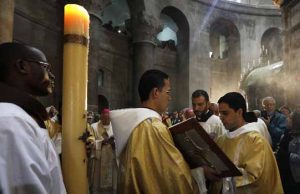
Hundreds of pilgrims filed into Jerusalem’s Church of the Holy Sepulchre — believed to be the site of Jesus’s resurrection — for Easter celebrations on Sunday.
Western Christians marked Easter on Sunday, while eastern Orthodox Christians do so on April 8.

The eastern Orthodox marked Palm Sunday on April 1 and also held mass at the church in Jerusalem’s Old City, with worshippers holding palm fronds as is tradition.

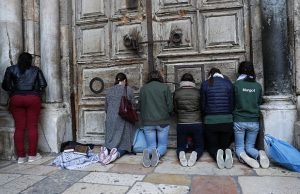
Some worshippers prostrated over a stone — where they believe Jesus’s body was anointed before his burial — near the towering wooden doors at the entrance to the church.

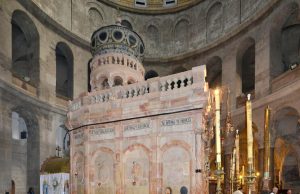
The church is built at the site where Christians believe Jesus was crucified, buried and resurrected. A recently renovated ornate shrine within the church surrounds the cave where Jesus is believed to have been buried.

Easter marks the day when Christians believe the miracle of his resurrection occurred.

Catholic Archbishop Pierbattista Pizzaballa held mass at the church on Sunday morning near the shrine over the cave, entering dressed in the traditional purple Easter robe.

He made reference to the Middle East’s numerous conflicts in his homily, saying “our times are marked by death”.

“Easter is the ability to come back and look at our history in the light of the promise of life that takes place today,” he said.
“Yes, today, at Easter, we announce a life that death can no more extinguish.”

On Friday, Christians traced the route of the Stations of the Cross through the Old City, which pass through the traditional sites of Jesus’s condemnation up to his crucifixion.

In March 2017, renovations to the 19th-century shrine covering Jesus’s tomb were unveiled following a $3.7 million project that restored its stones to their original reddish-yellow and reinforced the heavily visited site.

The Greek Orthodox, Armenian and Roman Catholic denominations share custody of the church, but disputes between the three had led to renovations being delayed for decades.

Follow us on Twitter

Church of the Holy Sepulchre in Jerusalem Re-opens

Church of the Holy Sepulchre in Jerusalem Re-opens

The Church of the Holy Sepulchre in Jerusalem’s Old City, seen by many as the holiest site in Christianity, reopened on Wednesday after a three-day closure to protest against Israeli tax measures and a proposed law, Times of Israel rports.

The two men who act as keepers of the key of the church opened its large wooden doors at around 4:00 a.m., ending the protest that began on Sunday at noon.

Wajeeh Nusseibeh, who is charge of locking and unlocking the church, climbed a stepladder and turned the key to open its main wooden door.

Shortly afterwards, a group of pilgrims arrived to visit the sacred site.

The church is built where Christians believe Jesus was crucified, buried and resurrected. Custody of it is shared by the Greek Orthodox, Armenian and Roman Catholic denominations.

According to Reuters, the rare decision on Sunday by church leaders to close the ancient holy site, a favorite among tourists and pilgrims, with the busy Easter holiday approaching put extra pressure on Israel to re-evaluate and suspend the moves.

“It’s one of the holiest sites for our religion and we prayed very hard these last three days that things would change and it would be open for us to be able to go in,” American pilgrim, who gave her name only as Laurie told Reuters.

The closure — which seemed to be the longest since at least 1990 — had left thousands of pilgrims and tourists seeking to visit locked outside.

Tuesday’s decision to call off the protest came after the Prime Minister’s office announced earlier in the day that it was suspending the tax collection and freezing the legislation until a newly formed committee — to be headed by Regional Cooperation  Minister Tzachi Hanegbi —  could work out the issues with the churches.

“After the constructive intervention of the Prime Minister, The Churches look forward to engage with Minister Hanegbi, and with all those who love Jerusalem, to ensure that Our Holy City, where our Christian presence continues to face challenges, remains a place where the three Monotheistic faiths may live and thrive together,” the church leaders said in a statement.

In addition to the Jerusalem Municipality suspending the tax collection actions it has taken in recent weeks, the government will also suspend all pending legislation regarding church land until the committee examines the issue, the Prime Minister’s Office announced, saying that the committee would work “with the participation of all relevant parties, to formulate a solution for the issue of municipal taxes on properties owned by churches that are not houses of worship.”

While the review of the tax plan is under way, work on legislation that would allow Israel to expropriate land in Jerusalem that churches have sold to private real estate firms in recent years will also be suspended, Israeli Prime Minister, Netanyahu said.

The bill’s declared aim is to protect homeowners against the possibility private companies will not extend their leases of land on which their residences stand.

Churches are major landowners in Jerusalem. They say such a law would make it harder for them to find buyers for their land- sales that help to cover operating costs of their religious institutions.

Holy Sepulchre Church Closed Over Tax Protest

Holy Sepulchre Church Closed Over Tax Protest

The doors of Jerusalem’s most sacred church, the Holy Sepulchre, have been closed until further notice due to a row over a new land law and tax.
Leaders at the church claimed the new rules are an attack on Christians in the Holy Land.

The site, which many Christians believe Jesus was crucified and buried, will remain closed until further notice, leaving disappointed pilgrims locked outside.

Dr Russell Rook, advisor to Theophilos III, the Patriarch of Jerusalem, told Premier why the proposed bill is so bad.

“It’s a bill that is due to go before the Knesset – the Israeli parliament, that would make it possible for the government of Israel to essentially confiscate church properties and properties owned by different churches… in Jerusalem,” he said during Premier’s News Hour.

“So this has been the issue that has pushed the church leaders in Jerusalem over the edge to say ‘this threatens our very existence as churches, as Christians in this holy city and enough is enough’.”

A statement was issued on Sunday signed by the Greek Orthodox Patriarch Theophilos III of Jerusalem, the Catholic Custos of the Holy Land, Fr Francesco Patton; the Armenian Patriarch of Jerusalem, Patriarch Nourhan Manougian and others.

It said that the campaign was a “discriminatory and racist bill”.

Announcing the closure of the 4th-century church, they condemned a “systematic and unprecedented attack against Christians in the Holy Land” that “severely violates the most basic… and sovereign rights, trampling on the delicate fabric of relations between the Christian community and the authorities for decades”.

Dr Rook urged Christians to pray for the nation.

“Pray for a peaceful resolution. Scripture tells us we’ve got to pray for the peace of Jerusalem, so we’re not trying to stir up a fight and certainly the Patriarch isn’t wanting to fight – he’s wanting peace.

“Pray that the discussions between the Christian leaders and the politicians in the municipality and the city of Jerusalem and in the Knesset – the Israeli government actually come to a peaceful conclusion and we get to a much better position.

“And if they want to act, they can write to their MP, or maybe even better – the Prime Minister… and say ‘would the UK use its influence to bring about a peaceful reconciliation to this really difficult problem?'”

Follow us on Twitter

Date of Holy Sepulchre Tomb of Jesus Revealed

Date of Holy Sepulchre Tomb of Jesus Revealed

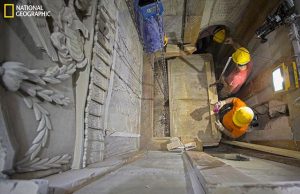
Scientific test results given to the National Geographic Magazine appear to back up the claims that the remains of a limestone cave enshrined in the church are part of the tomb where Jesus’ body was believed to have been placed.

“It’s corroborating what the historical accounts are telling us,” Kristin Romey, archaeology editor for National Geographic, told CBN News.

“Around 325-326 A.D., Constantine sends his delegation to the Holy Land to find the site associated with the life and death of Jesus,” she explained. “According to the historical accounts, they’re asking around, and they’re saying… ‘Where was the tomb of Jesus Christ?'”

“And the locals point to this Roman temple; they tear down the Roman temple; lo and behold, underneath it is a rock-cut tomb,” Romey continued.

Historical accounts show the tomb was found and enshrined around 326.

National Geographic reports that scientists sampled mortar located between the tomb’s original limestone surface and a marble slab on top of it that dates to around A.D. 345.

Prior to these recent tests, the oldest architectural evidence discovered in and around the complex of the tomb dated to the time of the Crusades, around 1,000 years ago.

“But now, scientists can confirm that it is indeed the site identified as the burial place of Christ 17 centuries ago,” a National Geographic news release states.

“We have a good amount of a limestone cave with a very typical kind of layout of what we call the burial bench that is still preserved within the walls of the Edicule [the shrine surrounding the tomb],” Romey told CBN News.

“I just remember being in that tomb and just kind of being really overwhelmed because this is one of the holiest, if not, the holiest site for the world’s largest religion… and to kind of be able to… see it in its original state and realize that this is a rock that people have fought and died for, for centuries,” she shared.

You can read more about the Church of the Holy Sepulchre in the December issue of National Geographic magazine or tune in to the National Geographic documentary, “The Secrets of Christ’s Tomb: Explorer Special,” premiering Sunday, Dec. 3 at 9/8c.